
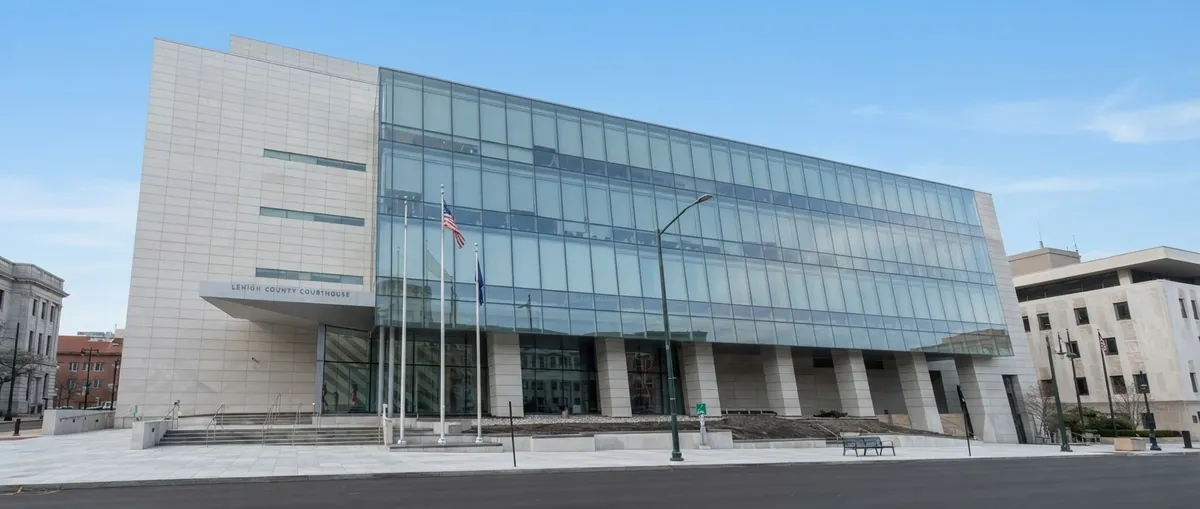
Court records in Lehigh County, Pennsylvania, are maintained by the Clerk of Judicial Records and are accessible through online tools, official court portals, and directly at the court office. LehighCourt.us can help you find publicly available information about the county's court records. Additionally, you can use the Pennsylvania Unified Judicial System portal, contact the court office, or submit a request through state government resources.
Lehigh Court System Overview
Lehigh County is part of the 31st Judicial District of Pennsylvania, which exclusively serves this county. The Court of Common Pleas handles all major civil, criminal, family, and probate cases. Magisterial District Judges operate in several offices throughout the county and handle less serious cases, preliminary hearings, and small claims.
The main court is located in the Lehigh County Courthouse building in Allentown:
The office typically operates Monday through Friday, from 8:30 AM to 4:30 PM. It is recommended to call ahead to confirm hours of operation.
Courts Serving Lehigh
Residents of the county are served by several levels of the judiciary—from local magistrates to federal courts.
State Court of Common Pleas
Magisterial District Courts
The county has several Magisterial District Courts located in different municipalities. The specific court depends on the place of residence or the location of the offense. Contact information for each magistrate can be found through the UJS portal.
Federal District Court
Federal Bankruptcy Court
Bankruptcy cases for county residents are handled by the U.S. Bankruptcy Court for the Eastern District of Pennsylvania, with the main office in Philadelphia.
What Types of Cases Lehigh Courts Hear
The county courts hear a wide range of cases. Here are the main categories:
- Criminal cases: felonies, misdemeanors, infractions
- Civil cases: claims of any amount, including small claims
- Family law: divorce, custody, child support, protective orders
- Probate: inheritance, guardianship, trust management
- Juvenile cases: juvenile offenses, child protection cases, adoptions
- Traffic violations and DUI
Details regarding the jurisdiction of each court level are described below.
District Court Cases in Lehigh
The Court of Common Pleas is the county's court of general jurisdiction. It handles serious criminal cases after a preliminary hearing by a magistrate, civil claims exceeding the jurisdiction of the magistrate court, and appeals from magistrate decisions. The court also addresses post-sentence motions and other complex procedural matters.
Cases are assigned to judges of the Court of Common Pleas according to the court's internal rules. Criminal cases are initiated by the District Attorney's Office after a magistrate determines sufficient grounds. Civil cases begin with the filing of a complaint with the Clerk of Judicial Records.
Magistrate Court Cases in Lehigh
Magisterial District Judges handle the initial stages of most cases. Their jurisdiction includes:
- Misdemeanors and infractions
- Preliminary hearings in felony cases
- Civil claims up to $12,000
- Small claims up to $12,000
- Traffic violation cases
- Initial hearings in DUI cases
- Eviction cases (landlord-tenant)
According to Pennsylvania law, the magistrate court handles civil claims where the dispute amount does not exceed $12,000. If the claim exceeds this amount, the case is filed directly with the Court of Common Pleas. Some magistrates in the county specialize in certain types of cases due to high demand, particularly traffic violations.
Family Law, Probate, and Juvenile Matters in Lehigh
Family Law
Divorces, child custody disputes, child support, protective orders from domestic violence (PFA), paternity establishment, and termination of parental rights are all handled by the Family Division of the Court of Common Pleas. Protective orders can be filed through the court office or through the prothonotary.
Probate
Matters of inheritance, appointment of guardians for incapacitated persons, and trust management are handled by the Orphans' Court Division, which operates within the Court of Common Pleas. The Register of Wills accepts initial documents for probate proceedings.
Juvenile Matters
Juvenile delinquency cases and child protection (dependency) cases are heard by a judge of the Court of Common Pleas assigned to the juvenile division. Juvenile case records are confidential under Pennsylvania law and are not publicly accessible.
How Cases Move Through the Lehigh Court System
- Initiation of the case. A criminal case begins with a complaint filed by the police or prosecutor. A civil case starts with a complaint, and family or probate cases with a petition.
- Preliminary hearing or arrest. In criminal cases, a magistrate conducts a preliminary hearing. In civil cases, the court schedules an organizational conference.
- Assignment of a judge. After being transferred to the Court of Common Pleas, the case is assigned to a specific judge.
- Pre-trial phase. Parties exchange evidence (discovery) and file motions. In criminal cases, plea negotiations may occur.
- Trial or resolution. The case concludes with a trial, settlement, plea agreement, or default judgment.
- Post-judgment. Sentencing in criminal cases, possibility of appeal, enforcement of judgments in civil cases.
Information about the status of any case can be checked through the UJS case search portal.
Court Administration, Local Rules, and Public Access in Lehigh
The Administrative Judge of the 31st Judicial District oversees the daily operations of the Court of Common Pleas of Lehigh County. The Trial Court Administrator coordinates scheduling, staffing, and administrative procedures.
Local court rules are published on the Pennsylvania Unified Judicial System website. These rules govern document filing procedures, deadlines, and specific requirements of the 31st District.
Public Access to Records
Most court records in Pennsylvania are public under the Unified Judicial System's Public Access Policy. Some records have restricted access:
- Juvenile cases are confidential
- Records sealed by court order
- Certain family cases with restricted access
To obtain public records, you can use the public records section on the UJS website or contact the office directly. Requests for municipal-level public documents are submitted through the Right-to-Know procedure.
Attending Hearings
Most court hearings are open to the public. Some hearings may be held remotely—confirm the format with the court office by calling (610) 782-3148.
Court Records and Related Court Resources in Lehigh
- Case search and docket sheets. The UJS Case Search portal allows free case searches by name, case number, or date. Docket sheets are available online but do not replace an official criminal history check.
- Criminal history checks. The PATCH (Pennsylvania Access To Criminal History) system provides official criminal history reports. This is the only way to obtain a full check conducted by the State Police.
- Inmate search. The Pennsylvania Department of Corrections Inmate Locator shows individuals in state facilities. For searches in the county jail (Lehigh County Jail), contact the Sheriff's Office.
- Vital records. Birth, marriage, and death certificates are issued by the Pennsylvania Department of Health.
- Property record monitoring. The county offers a free Record Alert program that notifies owners of any changes in their property records.
- State Police reports. Public Information Release Reports (PIRRs) are available on the Pennsylvania State Police website by the appropriate division.
- Real estate taxes. Information on assessment and tax payments can be found through Allentown city resources or the appropriate municipal tax office.
- Law enforcement agencies. Allentown Police and Salisbury Township Police are two of the many local divisions serving the county.